> For the complete documentation index, see [llms.txt](https://documentation.2pintsoftware.com/llms.txt). Markdown versions of documentation pages are available by appending `.md` to page URLs; this page is available as [Markdown](https://documentation.2pintsoftware.com/stifler/setup/prerequisites/networks.md).
# Network topology
When deploying the StifleR solution in your environment, it is important to consider your network topology.
An important concept to understand when working with Network Topologies in StifleR is the relationship between three network types:
* **Network –** an individual subnet.
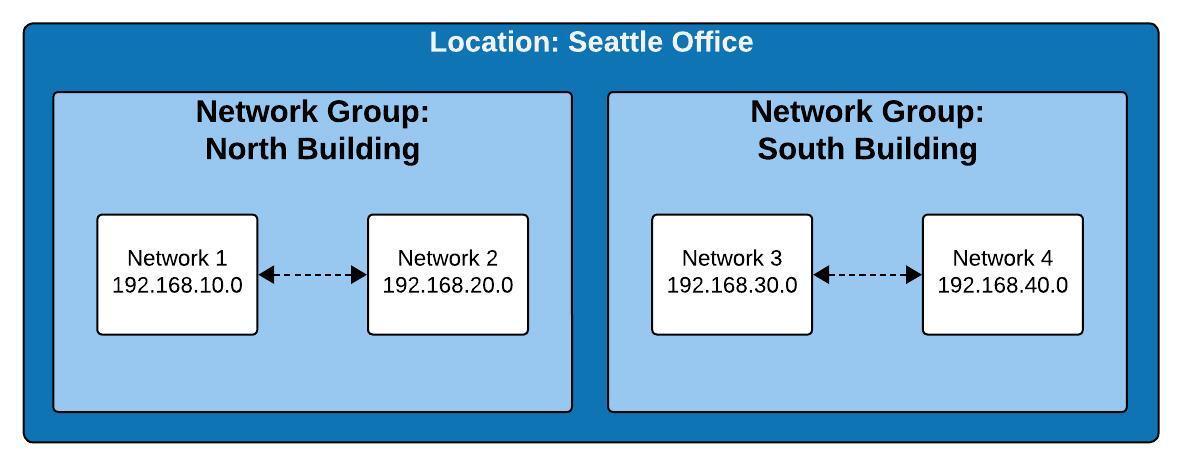
* **Network Group –** a Network Group contains one or more subnets (defined as Networks) which are reachable with good speed to each other.\
Some additional information:
* Traffic is not considered a cost inside a network group
* Designed to limit peer-to-peer traffic at certain sites
* Peer-to-peer traffic is never shared between network groups
* Bandwidth controls are applied to Network Groups, so understanding bandwidth limitations within this level of the topology is important to consider
* **Location –** represents a physical location in StifleR and contains one or several Network Groups. It contains physical information such as address, administrators etc. It defines a physical, worldly location, hence the name Location.
A Location can store one or several Network Groups which contain Networks.
The diagram below illustrates the logical structure of a StifleR network topology.
---
# Agent Instructions
This documentation is published with GitBook. GitBook is the documentation platform designed so that both humans and AI agents can read, navigate, and reason over technical content effectively. Learn more at gitbook.com.
## Querying This Documentation
If you need additional information that is not directly available in this page, you can query the documentation by asking a question.
Perform an HTTP GET request on the following URL with the `ask` and `goal` query parameters:
```
GET https://documentation.2pintsoftware.com/stifler/setup/prerequisites/networks.md?ask=&goal=
```
`ask` is the immediate question: it should be specific, self-contained, and written in natural language.
`goal` is what the user is ultimately trying to achieve, the reason they need the answer. Sharing it helps GitBook give you a better, more relevant answer. A goal is most helpful when it describes the outcome the user wants rather than restating the question. For example, with `ask=how do I create an API token`, a goal like `automate deployments from our CI pipeline` lets GitBook tailor the answer to that use case.
The response will contain a direct answer to the question and relevant excerpts and sources from the documentation.
Use this mechanism when the answer is not explicitly present in the current page, you need clarification or additional context, or you want to retrieve related documentation sections.