> For the complete documentation index, see [llms.txt](https://documentation.2pintsoftware.com/llms.txt). Markdown versions of documentation pages are available by appending `.md` to page URLs; this page is available as [Markdown](https://documentation.2pintsoftware.com/stifler/configuration/windows-server-branchcache-configuration.md).
# Windows Server BranchCache Configuration
## Enabling BranchCache on ConfigMgr Distribution Points
BranchCache is a Windows feature that enables peer-to-peer content sharing between clients on the same network. When used with Microsoft Configuration Manager (ConfigMgr), BranchCache allows clients to download content from a local peer instead of repeatedly downloading the same content from a remote distribution point (DP). This can significantly reduce WAN bandwidth consumption and improve deployment performance.
For BranchCache to function correctly with Configuration Manager, it must be enabled both in **Windows Server** and in the **Configuration Manager distribution point configuration**.
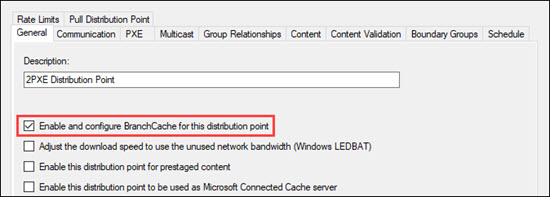
In the Configuration Manager console, open the **Administration** workspace and expand **Site Configuration** and select **Servers and Site System Roles**. Select which distribution points you want to enable and open the distribution point **Properties**. Under the "General" tab, choose the option: Enable and configure BranchCache for this distribution point.
To allow clients to retrieve BranchCache content from a distribution point, BranchCache must be enabled in the Configuration Manager console.
#### Steps
1. Open the **Configuration Manager Console**.
2. Navigate to:
Administration → Site Configuration → Servers and Site System Roles
3. Select the server hosting the **Distribution Point** role.
4. Open the **Distribution Point Properties**.
5. On the **General** tab, enable:
Once this option is enabled, Configuration Manager will automatically install the **BranchCache Windows feature** on the distribution point if it is not already installed.
### Enable BranchCache on a Distribution Point Using PowerShell
BranchCache can also be enabled through PowerShell when connected to the Configuration Manager environment.
{% hint style="info" %}
Replace \ with the fully qualified domain name of the distribution point.
{% endhint %}
```powershell
Set-CMDistributionPoint -EnableBranchCache $true -SiteSystemServerName
```
{% hint style="info" %}
If you are using more than one DP, the BranchCache 'Server Secret' is the same on each of them. The 'Server Secret' is stored in the registry:
HKLM:\Software\Microsoft\Windows NT\CurrentVersion\PeerDist\SecurityManager\Restricted
Value: Seed
If you have configured BranchCache functionality using the ConfigMgr UI then the same server secret will be automatically seeded across DPs.
{% endhint %}
## Enabling BranchCache in Windows Server
BranchCache can also be installed directly in Windows Server using either the graphical interface or PowerShell.
### Using Windows Server Manager
1. Open **Server Manager**.
2. Navigate to **Add Roles and Features**.
3. Select the **BranchCache** feature and install it.
### Using PowerShell
```powershell
Install-WindowsFeature -Name BranchCache
```
## Verify BranchCache Installation
You can verify that BranchCache is installed on the distribution point by running the following PowerShell command:
```powershell
Get-WindowsFeature | ? name -eq BranchCache
```
If the feature is installed, it will appear in the list with the status **Installed**.
## Modifying the BranchCache Cache Location
On a distribution point, you may want to move the BranchCache cache folder to a different disk for performance or capacity reasons.
Example: Move the cache to `D:\BranchCache\LocalCache`
1. Create the target directory.
2. Run the following command:
```
netsh br set localcache directory=D:\BranchCache\Localcache
```
## Modifying the BranchCache Cache Size
You can configure the size of the BranchCache cache using the following command:
```
netsh br set cachesize
```
Usage:
```
set cachesize [size=]{DEFAULT|} [[percent=]{TRUE|FALSE}]
```
Examples:
```
set cachesize DEFAULT
set cachesize 20971520
set cachesize size=20 percent=TRUE
```
## Data Deduplication and BranchCache
Data Deduplication is a Windows Server feature that reduces storage consumption by identifying and eliminating duplicate blocks of data.
When used together with BranchCache, Data Deduplication provides an additional performance advantage.
Both technologies use the same hashing algorithm. When Data Deduplication is enabled on a distribution point, the deduplication engine calculates content hashes during its scheduled optimization process. These hashes can then be reused by BranchCache when serving content to clients.
This provides two important benefits:
* Reduces CPU load on the distribution point during content requests
* Avoids potential time-out issues caused by on-demand hash calculations
Additionally, Data Deduplication reduces storage usage and network traffic by minimizing redundant data blocks.
For these reasons, **2Pint Software strongly recommends enabling Data Deduplication on distribution points used with BranchCache.**
## Enabling Data Deduplication on a Distribution Point
The following PowerShell script enables Data Deduplication on a distribution point volume.
{% hint style="info" %}
Update the `$dedupVolume` variable to match the drive letter used for Configuration Manager content.
{% endhint %}
```powershell
#Set the drive letter
$dedupVolume = "E:"
Import-Module ServerManager
Add-WindowsFeature -Name FS-Data-Deduplication
#Enable Deduplication on the volume
Enable-DedupVolume $dedupVolume
Set-DedupVolume -Volume $dedupVolume -MinimumFileAgeDays 0 -ExcludeFolder $dedupVolume\SMSPKG, $dedupVolume\SMSPKGSIG, $dedupVolume\SMSSIG$
Write-Output "Starting Dedup Jobs..."
$j = Start-DedupJob -Type Optimization -Memory 75 -Priority High -Volume $dedupVolume
$j = Start-DedupJob -Type GarbageCollection -Full -Memory 75 -Priority High -Volume $dedupVolume
$j = Start-DedupJob -Type Scrubbing -Full -Memory 75 -Priority High -Volume $dedupVolume
do
{
Write-Output "Dedup jobs running. Status:"
$state = Get-DedupJob | Sort-Object StartTime -Descending
$state | ft
if ($state -eq $null) {Write-Output "Completing, please wait..."}
sleep -s 5
} while ($state -ne $null)
Write-Output "Done DeDuping"
Get-DedupStatus | fl *
```
---
# Agent Instructions
This documentation is published with GitBook. GitBook is the documentation platform designed so that both humans and AI agents can read, navigate, and reason over technical content effectively. Learn more at gitbook.com.
## Querying This Documentation
If you need additional information that is not directly available in this page, you can query the documentation dynamically by asking a question.
Perform an HTTP GET request on the current page URL with the `ask` query parameter, and the optional `goal` query parameter:
```
GET https://documentation.2pintsoftware.com/stifler/configuration/windows-server-branchcache-configuration.md?ask=&goal=
```
`ask` is the immediate question: it should be specific, self-contained, and written in natural language.
`goal` is optional and describes the broader end goal you are ultimately trying to accomplish on behalf of the user. GitBook uses it to tailor the answer towards what is most useful for that goal.
The response will contain a direct answer to the question and relevant excerpts and sources from the documentation.
Use this mechanism when the answer is not explicitly present in the current page, you need clarification or additional context, or you want to retrieve related documentation sections.