> For the complete documentation index, see [llms.txt](https://documentation.2pintsoftware.com/llms.txt). Markdown versions of documentation pages are available by appending `.md` to page URLs; this page is available as [Markdown](https://documentation.2pintsoftware.com/deployr/reference/step-definitions/inject-drivers-from-cloud.md).
# Inject drivers from cloud
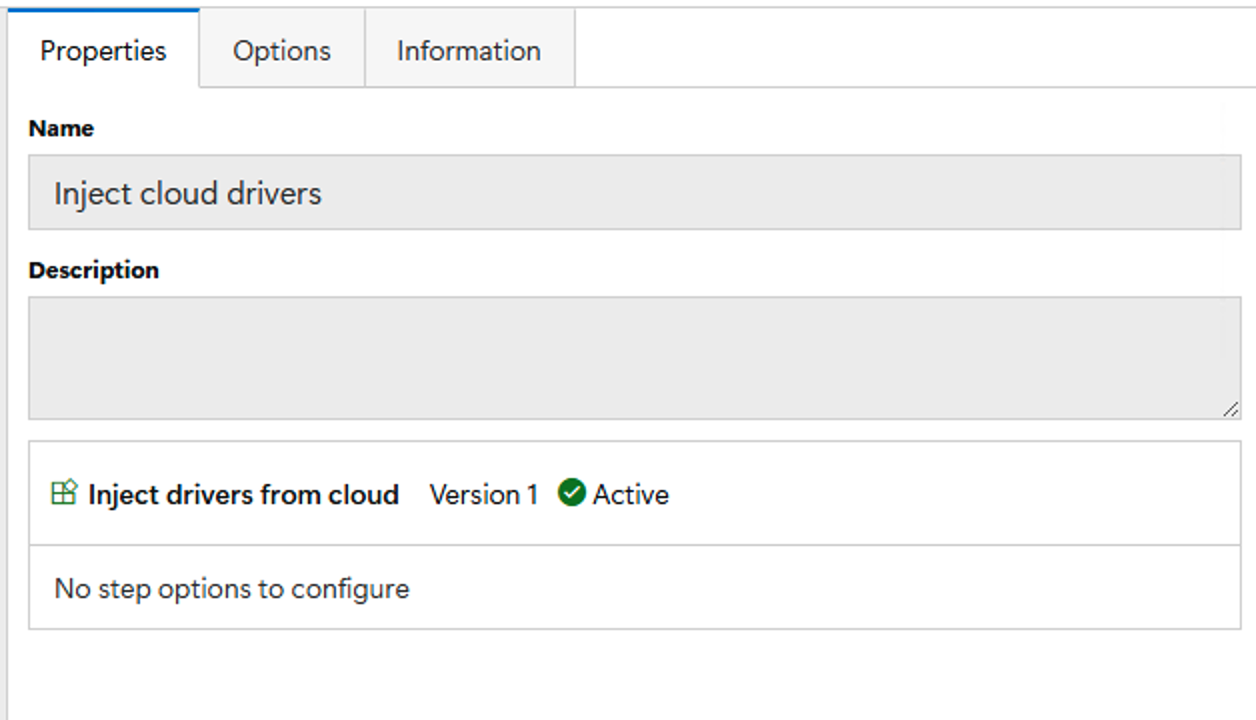
The **Inject drivers from cloud** step automatically downloads and extracts a matching driver pack from the device manufacturer's website.
This process is normally performed in Windows PE to ensure that the disk and network drivers required to resume the DeployR task sequence are available.
### Hash verification
Each downloaded driver pack is checked against the SHA256 hash in the manufacturer's catalog, and the step fails if the hash does not match. Starting with DeployR 1.4, the **Skip hash check** option uses the driver pack anyway and logs a warning instead of failing. Only turn it on when a manufacturer has published a catalog entry with an incorrect hash. Default: `false`.
### Using Cloud Drivers as Fallback
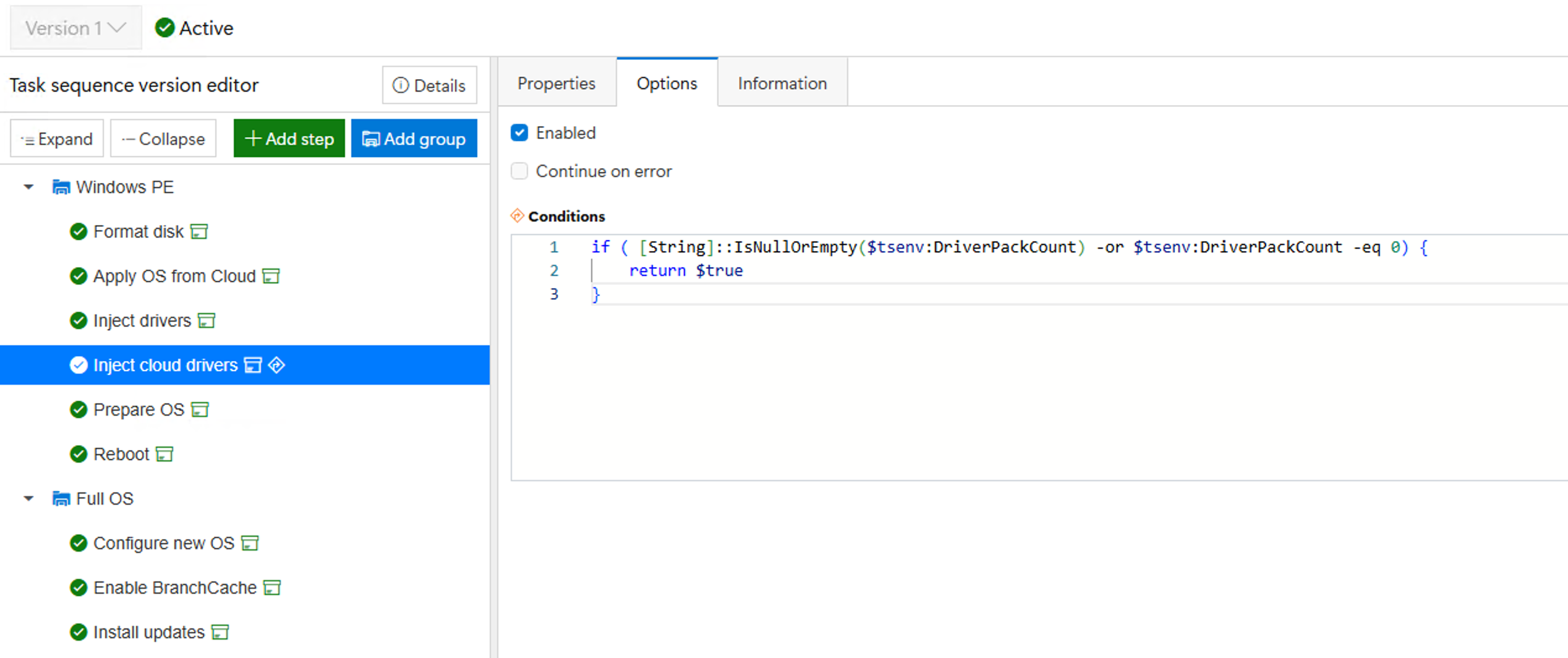
To use **Inject drivers from cloud** as a fallback when the DeployR server does not have drivers for a specific model, add both steps to your task sequence and configure a condition on the cloud driver step.
```powershell
if ( [String]::IsNullOrEmpty($tsenv:DriverPackCount) -or $tsenv:DriverPackCount -eq "0") {
return $true
}
```
---
# Agent Instructions
This documentation is published with GitBook. GitBook is the documentation platform designed so that both humans and AI agents can read, navigate, and reason over technical content effectively. Learn more at gitbook.com.
## Querying This Documentation
If you need additional information that is not directly available in this page, you can query the documentation by asking a question.
Perform an HTTP GET request on the following URL with the `ask` and `goal` query parameters:
```
GET https://documentation.2pintsoftware.com/deployr/reference/step-definitions/inject-drivers-from-cloud.md?ask=&goal=
```
`ask` is the immediate question: it should be specific, self-contained, and written in natural language.
`goal` is what the user is ultimately trying to achieve, the reason they need the answer. Sharing it helps GitBook give you a better, more relevant answer. A goal is most helpful when it describes the outcome the user wants rather than restating the question. For example, with `ask=how do I create an API token`, a goal like `automate deployments from our CI pipeline` lets GitBook tailor the answer to that use case.
The response will contain a direct answer to the question and relevant excerpts and sources from the documentation.
Use this mechanism when the answer is not explicitly present in the current page, you need clarification or additional context, or you want to retrieve related documentation sections.