> For the complete documentation index, see [llms.txt](https://documentation.2pintsoftware.com/llms.txt). Markdown versions of documentation pages are available by appending `.md` to page URLs; this page is available as [Markdown](https://documentation.2pintsoftware.com/deployr/reference/step-definitions/enable-administrator-account.md).
# Enable Administrator account
Must be run while in Full OS
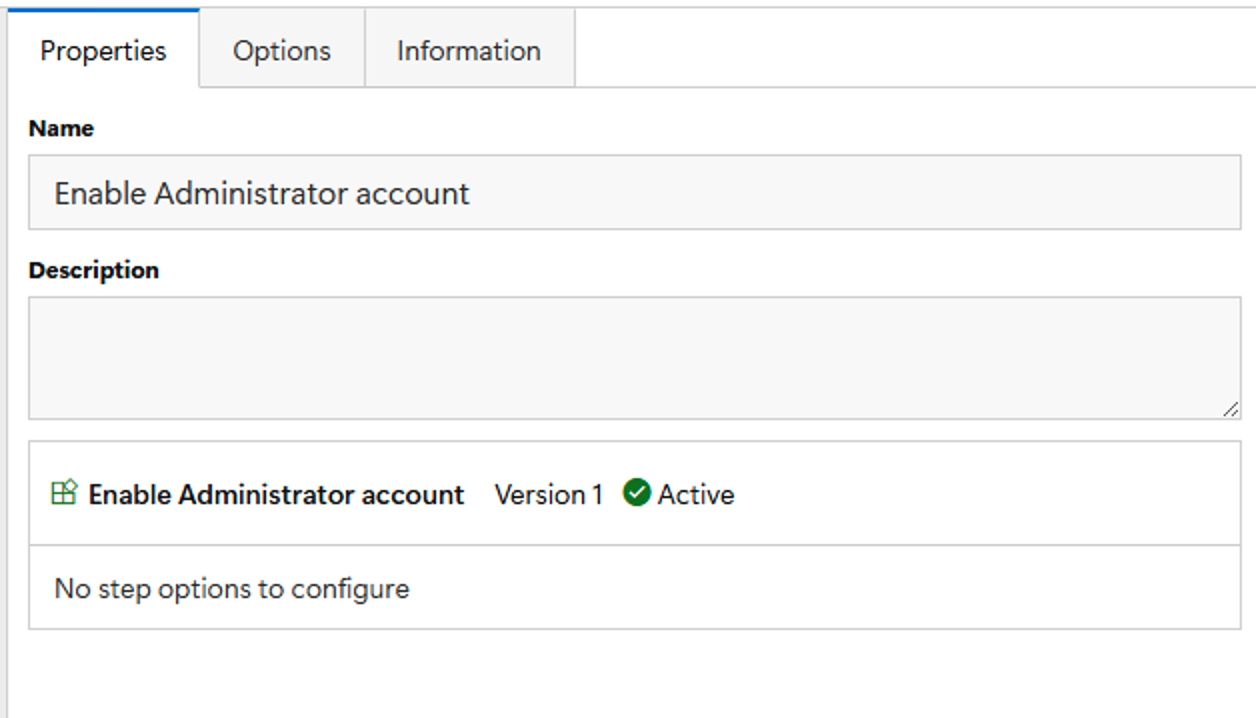
The **Enable Administrator account** step ensures that the local Administrator account is enabled and configured with a password. This can be useful for troubleshooting.
The value of the `AdminPassword` task sequence variable is used as the password. If this variable is not set, a default value is retrieved.
As a best practice, use Windows LAPS or a similar tool to rotate the local Administrator account password to a unique value and securely store it for future use.
### Setting the Default Administrator Password
To set the default password, use the `AdminPassword` variable. Set this variable before the **Enable Administrator account** step. You can set the variable using PowerShell or the built-in [**Set variable**](/deployr/reference/step-definitions/set-variable.md) step. Note that variables are written to the DeployR log. As mentioned above, use LAPS to manage and secure the local Administrator account after OSD.
### Behind the scenes
This step retrieves the password from the Secure password store or from the task sequence variable, then enables the local Administrator account and sets its password.
```powershell
Get-LocalUser | Where-Object {$_.SID -match "S-1-5-.*-500"} | ForEach-Object {
$_ | Enable-LocalUser
$_ | Set-LocalUser -Password $password -PasswordNeverExpires $true
}
```
---
# Agent Instructions
This documentation is published with GitBook. GitBook is the documentation platform designed so that both humans and AI agents can read, navigate, and reason over technical content effectively. Learn more at gitbook.com.
## Querying This Documentation
If you need additional information that is not directly available in this page, you can query the documentation by asking a question.
Perform an HTTP GET request on the following URL with the `ask` and `goal` query parameters:
```
GET https://documentation.2pintsoftware.com/deployr/reference/step-definitions/enable-administrator-account.md?ask=&goal=
```
`ask` is the immediate question: it should be specific, self-contained, and written in natural language.
`goal` is what the user is ultimately trying to achieve, the reason they need the answer. Sharing it helps GitBook give you a better, more relevant answer. A goal is most helpful when it describes the outcome the user wants rather than restating the question. For example, with `ask=how do I create an API token`, a goal like `automate deployments from our CI pipeline` lets GitBook tailor the answer to that use case.
The response will contain a direct answer to the question and relevant excerpts and sources from the documentation.
Use this mechanism when the answer is not explicitly present in the current page, you need clarification or additional context, or you want to retrieve related documentation sections.